India Writes a New Chapter of Digital Democracy: ‘AI for All’ and the Democratisation of AI
In the words of Prime Minister Narendra Modi, the digital journey is the reward of the trust and courage of more than 140 crore Indians- Sarman Nagele
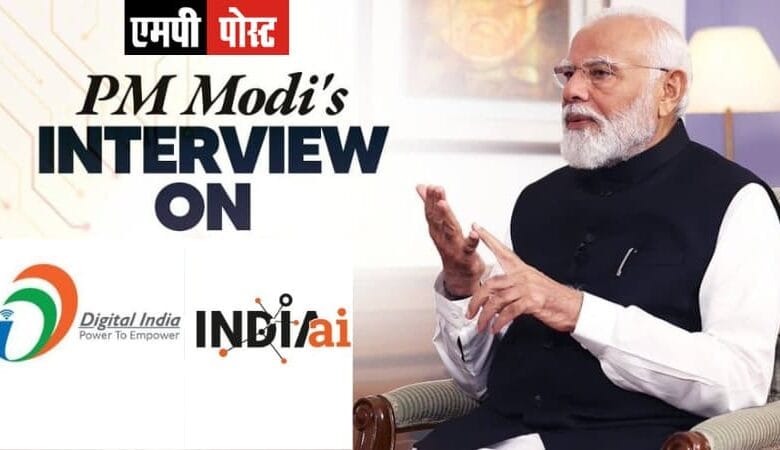
( Sarman Nagele )
“India has written a historic chapter whose vision was conceived by a statesman whose results have not only begun to emerge under his very own leadership, but a new chapter of digital democracy has been written – and alongside it, India’s technology transformation has become its greatest identity, because it has transformed governance, financial inclusion, and citizen participation – all three. From dial-up internet to Artificial Intelligence, cloud computing, and Digital Public Infrastructure, technology has been made the greatest foundational pillar of people’s empowerment. These are the foremost efforts of India’s digital democracy and digital revolution – where technology has become an instrument of equal opportunity, transparency, and the new strength of Aatmanirbhar Bharat for Indian citizens, and where India is seen giving the world a new technology model through UPI, DPI, AI, and Digital India. India has made digital technology not merely a convenience, but a medium of equality, transparency, and access.”
“Now, ten years ago, India had begun a bold journey into uncharted territory with great conviction. For decades, Indians’ capacity to use technology was doubted. This approach was changed by India and by the leadership of Prime Minister Shri Narendra Modi, who established trust in Indians’ ability to use technology. For decades, it was believed that the use of technology would deepen the divide between the haves and the have-nots. India’s Prime Minister not only changed this mindset but also drew a blueprint for using technology to eliminate the gap between the affluent and the deprived – one that left the world in awe – and India suddenly emerged as a global leader when the New Delhi Declaration of the India AI Impact Summit 2026 was adopted and endorsed by 91 countries and international organisations. This is a significant milestone in global cooperation on Artificial Intelligence. The endorsement by 91 countries and international organisations particularly underscores a broad global consensus on leveraging AI for economic development and social welfare.
It would not only be timely but also entirely apt to mention here that at the very moment when Finland was appreciating the significant contributions made by Indian professionals in the development and innovation of Finland’s technology sector, Prime Minister Shri Narendra Modi – while underlining the pivotal role of digitalisation – was reviewing on 19 May 2026 in Finland the ongoing cooperation in the fields of digitalisation, AI – Artificial Intelligence, 5G, 6G, quantum technologies, innovation, mobility, and people-to-people ties; at that very same moment, India was seen leading swiftly and decisively in the direction of writing a new chapter of digital democracy, ‘AI for All’, and the democratisation of AI.
When the intent is right, innovation empowers the less empowered. When the approach is inclusive, technology brings change to the lives of those on the margins – which has now become reality.”
“There was a time when the world doubted India’s technological capabilities and it was believed that technology would only widen the gap between the rich and the poor. But over the past decade, India has completely transformed this perception. In the words of Prime Minister Narendra Modi, this journey is not merely about code and computers – it is a digital journey of the trust and courage of more than 140 crore Indians. This ‘technology revolution’ from idea to vision has today reached from the street vendors in the lanes to the icy peaks of Siachen. How a ‘bold journey’ transformed India from a consumer of technology into a trusted ‘innovation partner’ for the world.”
The India AI Impact Summit 2026 was recently held in the nation’s capital, New Delhi. This was the first time such a large-scale global meeting on Artificial Intelligence took place in the Global South. The thoughts that Prime Minister Narendra Modi shared in the context of this Summit were: “Sarvajan Hitaya, Sarvajan Sukhaya” – for the welfare of all, for the happiness of all. The Summit was attended by heads of state and government, ministers, global technology leaders, and representatives of the industry from various countries. The stakeholders present at the Summit discussed how AI can be used to advance inclusive growth, strengthen public systems, and accelerate sustainable development.
Prime Minister Modi’s view was that, emphasising India’s vision for this new era, AI must remain fully human-centric while accelerating global development.
The context then affirms “the great confluence of democracy and technology” – that “India’s digital revolution is no longer merely a figure of data and dashboards, but a living saga of the democratisation of opportunities. The Government of India’s ‘Digital India’ is no longer just a government programme – it has become a nationwide people’s movement that has empowered citizens directly by eliminating middlemen. When the intent is right and the approach is inclusive, technology does bring light to the lives of those on the margins – which is visible everywhere.”
“In India’s journey from ‘India-First’ to ‘India-for-the-World’, citizens are not only solving their own problems but also writing a new chapter of global leadership through humanity-first AI.”
Now, if one reflects on the change in mindset, one finds: transforming doubt about Indians’ technological capacity into trust, inclusive development, bridging the gap between the haves and the have-nots.
How India’s goal of ‘India-for-the-World’ and becoming a global digital leader is taking shape as an important milestone in the direction of democratisation: connecting small entrepreneurs and the common man to global markets through GeM and ONDC; India’s ‘India-for-the-World’ goal and becoming a global digital leader. This belief laid the foundation of Digital India – a mission to democratise access, build inclusive digital infrastructure, and provide opportunities for all.
These figures tell the story: In 2014, internet access was limited, digital literacy was low, and online access to government services was rare. Many doubted whether a vast and diverse country like India could truly go digital. Today, the answer to that question lies not only in data and dashboards, but in the lives of more than 140 crore Indians. How people govern, how they learn, how they transact, and how they create – Digital India is everywhere. If one doesn’t believe it, one can simply visit a vegetable market, a haat bazaar, or any market where money is exchanged through QR codes and confirmation of payment is received through voice.
Bridging the Digital Divide:
By the end of March 2026, the total number of broadband internet subscribers in India had grown to 106.58 crore (1,065.88 million). This is an unprecedented increase.
More than 42 lakh kilometres of optical fibre cable – 11 times the distance between the Earth and the Moon – now connects even the most remote villages.
India’s rollout of 5G has been the fastest in the world, with 4.81 lakh base stations established in just two years. High-speed internet has now reached urban centres as well as forward military posts including Galwan, Siachen, and Ladakh.
India Stack, our digital backbone, has enabled platforms like UPI, which now handles 100+ billion transactions annually. Nearly half of all real-time digital transactions in the world take place in India.
Through Direct Benefit Transfer (DBT), more than Rs 44 lakh crore has been transferred directly to citizens, eliminating middlemen and saving Rs 3.48 lakh crore in leakage.
Schemes like SVAMITVA have issued more than 2.4 crore property cards and mapped 6.47 lakh villages, bringing an end to years of land-related uncertainty.
Democratisation of Opportunity for All:
India’s digital economy is empowering MSMEs and small entrepreneurs more than ever before. ONDC (Open Network for Digital Commerce) is a revolutionary platform that opens a new window of opportunities by providing seamless connection with a vast marketplace of buyers and sellers.
GeM (Government e-Marketplace) enables the common man to sell goods and services to all arms of the government. This not only empowers the common man with a vast market but also saves money for the government.
Imagine: you apply online for a Mudra loan. Your creditworthiness is assessed through the Account Aggregator framework. You receive your loan and start your enterprise. You register on GeM, supply to schools and hospitals, and then grow further through ONDC.
ONDC recently crossed 200 million transactions, with the last 100 million having taken place in just six months. From Banarasi weavers to bamboo artisans of Nagaland, sellers are now reaching customers across the country without any middlemen or digital monopolies.
GeM has also crossed Rs 1 lakh crore GMV in 50 days, with 22 lakh sellers – including more than 1.8 lakh women-led MSMEs — having fulfilled orders worth Rs 46,000 crore.
Digital Public Infrastructure: India’s Global Offering
From Aadhaar, CoWIN, DigiLocker, and FASTag to PM-WANI and One Nation One Subscription, India’s Digital Public Infrastructure (DPI) is now being studied and adopted at the global level.
CoWIN enabled the world’s largest vaccination drive, issuing 220 crore QR-verifiable certificates. DigiLocker, with 54 crore users, securely and seamlessly hosts more than 775 crore documents.
Through the G20 Presidency, India launched the Global DPI Repository and a $25 million Social Impact Fund, helping countries in Africa and South Asia adopt inclusive digital ecosystems.
The Confluence of Startup Power and Aatmanirbhar Bharat:
India is now among the top 3 startup ecosystems in the world, with more than 1.8 lakh startups. But this is far more than a startup movement – it is a technological renaissance.
When it comes to AI skill penetration among youth and AI talent concentration, India is performing very well.
Through the $1.2 billion India AI Mission, India has enabled access to up to 34,000 GPUs at globally unmatched prices — less than $1 per GPU per hour – making India not only the most affordable internet economy but also the most affordable compute destination.
India has championed humanity-first AI. The New Delhi Declaration on AI promotes innovation with responsibility. The process of establishing AI Centres of Excellence in India has already begun.
The Road Ahead:
The next decade will be even more transformative. We are moving from digital governance to global digital leadership, from India-first to India-for-the-world. Digital India is no longer just a government programme – it has become a people’s movement. It is integral to building an Aatmanirbhar Bharat and making India a trusted innovation partner for the world.
For all innovators, entrepreneurs, and dreamers: the world is looking to India for the next digital breakthrough.
There was a time when internet in India meant a telephone dial tone, slow speed, and limited reach. Technology was considered confined to cities, English speakers, and the affluent. The belief was deeply entrenched that the digital world would increase inequality in society rather than equality. But a thought that took shape a decade ago completely changed this mindset.
A deep study of the blogs, articles, and public thoughts shared by India’s Prime Minister Narendra Modi over time reveals that India’s digital journey is not merely a story of technological change – it is a new definition of trust, inclusion, and democratic empowerment. This was a vision in which technology was considered not an “elite tool” but a “medium of people’s empowerment.”
The concept of Digital India, for the first time, placed technology in the hands of the common Indian – from a woman in the village to a small shopkeeper, from a startup youth to a soldier on the border. This is precisely why India today is not merely a digital consumer, but is emerging as a global leader giving the world a model of Digital Public Infrastructure, UPI, DPI, AI, and inclusive technology.
In Prime Minister Shri Modi’s articles and blogs, one thing consistently stands out – “When the intent is inclusive, technology does not merely provide convenience; it transforms the direction of society.” This journey – from floppy disks and dial-up internet to AI, 5G, ONDC, and the India AI Mission – is in fact the story of new India’s technological self-reliance and global digital leadership.
India’s Prime Minister Narendra Modi has consistently shared with the nation – through his blogs and other written articles from time to time – the direction of the future, development priorities, and the vision of technology-driven transformation. His numerous blogs consistently highlight subjects such as Digital India, Artificial Intelligence, startups, innovation, data, semiconductors, 5G, digital governance, and technology-based public service. Prime Minister Shri Modi has repeatedly emphasised in his writings that technology is not merely a medium of convenience but the greatest instrument of social transformation and democratic empowerment. His belief has been that India’s future will be built on Digital Public Infrastructure, data-driven administration, and youth innovation.
Digital India: The Effort to Make Technology a People’s Movement:
Prime Minister Shri Modi, in his many blogs and articles, has described Digital India not as a mere government programme, but as a campaign for social and economic change. According to him, digital technology has reduced the distance between villages and cities. He has described platforms like UPI, DigiLocker, Aadhaar, CoWIN, and digital payments as India’s new identity.
Startups and Innovation: The New Strength of Young India:
In his articles, the Prime Minister has inspired India’s youth to move from being ‘job seekers’ to ‘job creators’. He has described the Startup India campaign as the country’s new energy. He has regarded AI, fintech, healthtech, agritech, and deep tech startups as the foundation of Aatmanirbhar Bharat.
Artificial Intelligence and the India of Tomorrow:
Prime Minister Shri Modi has described AI as the most transformative technology of the future. In his vision, AI can play a revolutionary role not only for industry but also for education, health, agriculture, and governance. He has promoted the concept of ‘AI for All’ and described India as a proponent of responsible AI development. Prime Minister Shri Modi’s pioneering role in democratising AI has been reflected prominently at the global level.
5G, Semiconductors, and Digital Infrastructure:
In Prime Minister Shri Modi’s blogs, the 5G and Semiconductor Mission have been described as the engine of the future economy. The Prime Minister believes that data, connectivity, and chip manufacturing will determine the global balance of power in the times to come. The government is continuously investing and undertaking policy reforms in the direction of making India a technology-manufacturing nation.
Digital Governance: Transparency and Speed:
Prime Minister Shri Modi has described technology-driven administration as a new model of good governance. According to him, technology has reduced corruption, increased the speed of services, and directly connected the common citizen to governance. He has regarded DBT, online services, and digital platforms as important steps in the direction of ‘Minimum Government, Maximum Governance.’
A study of the blogs at https://www.narendramodi.in/hi/blog and articles of India’s Prime Minister Shri Narendra Modi makes it clear that technology is at the centre of his vision for development. He has regarded Digital India not merely as a technology project, but as a medium of social transformation, transparency, self-reliance, and global leadership. India has today become a model of Digital Public Infrastructure for the world. In the years to come, AI, quantum technology, semiconductors, and digital innovation can become India’s new identity. Prime Minister Modi’s blogs indicate that India is moving in the direction of becoming not merely a consumer of technology, but the technological leader of the future. The next decade will be full of innovations, complete with creative vitality, and even more transformative. The groundwork has already been laid. It will not take long to witness this – because governance, administration, technocrats, experts, stakeholders, and India’s aware society are all contributing diligently at their respective levels.
(Author: Founder Editor of Madhya Pradesh’s first news portal MP Post, creator of the book Digital MP, and associated with digital journalism for the past 25 years)